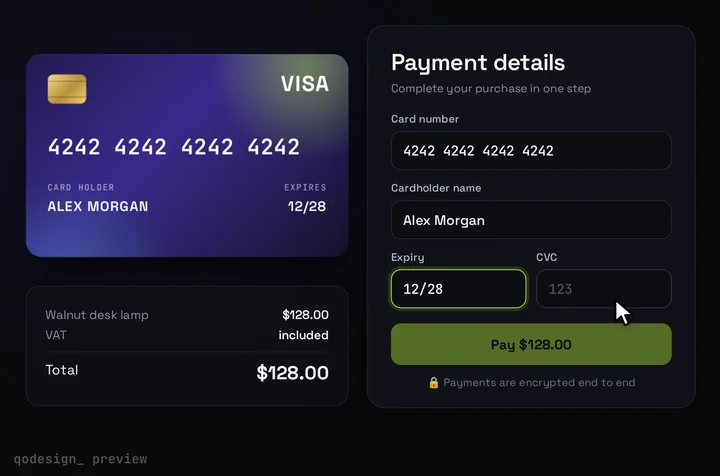
Use it in Next.js
app/pay/checkout.tsx
"use client";
import { useEffect, useRef, useState } from "react";
import { useRouter } from "next/navigation";
import { loadVGSCollect } from "@vgs/collect-js";
import type { IVGSCollect, IVGSCollectForm, VGSCollectFormState } from "@vgs/collect-js-react";
import CardCheckout, { type CardFieldsSlot } from "@/components/CardCheckout";

type Submit = (cardholder: string) => Promise<unknown>;

const vaultId = process.env.NEXT_PUBLIC_VGS_VAULT_ID!;

// Load Collect.js once per page, even when Strict Mode runs effects twice.
// The loader resolves to the global VGSCollect object; the React package ships its type.
let collect: Promise<IVGSCollect> | undefined;
const loadCollect = () =>
  (collect ??= loadVGSCollect({ vaultId, environment: "sandbox", version: "4.0.1" }) as Promise<IVGSCollect>);

// The fields are iframes and don't read Tailwind, so their text is styled here.
const css = {
  color: "#F4F4F6",
  "font-size": "19px",
  "font-family": "ui-monospace, SFMono-Regular, Menlo, monospace",
  "&::placeholder": { color: "#4a4f61" },
};

function VgsFields({ slot, onReady }: { slot: CardFieldsSlot; onReady: (submit: Submit | null) => void }) {
  useEffect(() => {
    let gone = false;
    let form: IVGSCollectForm | undefined;

    // Runs on every keystroke and focus change, with one entry per field.
    const stateCallback = (state: VGSCollectFormState) => {
      if (!state) return;
      const fields = Object.values(state);
      slot.onChange({
        complete: fields.length === 3 && fields.every((f) => f.isValid),
        brand: state.card_number?.cardType ?? null, // "visa", "mastercard", "amex"...
      });
    };

    (async () => {
      const VGSCollect = await loadCollect();
      // Collect.js 4 replaces the deprecated create() with session().
      const f = await VGSCollect.session({ vaultId, env: "sandbox", stateCallback });
      form = f;
      if (gone) return f.unmount();

      f.field("#vgs-number", {
        type: "card-number",
        name: "card_number",
        validations: ["required", "validCardNumber"],
        // Required by the 2.1.1 types. List the brands you take: in our test an empty array rejected every card.
        validCardBrands: [{ type: "visa" }, { type: "mastercard" }, { type: "amex" }],
        placeholder: "1234 5678 9012 3456",
        autoComplete: "cc-number",
        css,
      });
      f.field("#vgs-expiry", {
        type: "card-expiration-date",
        name: "card_exp",
        validations: ["required", "validCardExpirationDate"],
        yearLength: 2,
        placeholder: "MM / YY",
        autoComplete: "cc-exp",
        css,
      });
      const cvc = f.field("#vgs-cvc", {
        type: "card-security-code",
        name: "card_cvc",
        validations: ["required", "validCardSecurityCode"],
        placeholder: "123",
        autoComplete: "cc-csc",
        css,
      });
      cvc.on("focus", () => slot.onChange({ focus: "cvc" })); // flips the card
      cvc.on("blur", () => slot.onChange({ focus: null }));

      // Pay sends the three fields through your vault's inbound route.
      // Your server receives aliases in their place, never the card number.
      onReady(
        (cardholder) =>
          new Promise((resolve, reject) =>
            f.submit(
              "/api/vgs/charge",
              { data: (fields: Record<string, unknown>) => ({ ...fields, cardholder }) },
              (status, data) =>
                typeof status === "number" && status < 300 ? resolve(data) : reject(new Error("That card didn't go through.")),
              () => reject(new Error("Check the card details.")),
            ),
          ),
      );
    })();

    return () => {
      gone = true;
      onReady(null);
      form?.unmount();
    };
  }, [slot, onReady]);

  // Collect.js sizes its iframe from the box it lands in, so let it fill the slot's box.
  const box = `${slot.fieldClassName} [&_iframe]:h-full`;

  return (
    <div className="space-y-3">
      <div>
        <label className={slot.labelClassName}>Card number</label>
        <div id="vgs-number" className={box} />
      </div>
      <div className="flex gap-3">
        <div className="flex-1">
          <label className={slot.labelClassName}>Expiry</label>
          <div id="vgs-expiry" className={box} />
        </div>
        <div className="flex-1">
          <label className={slot.labelClassName}>CVC</label>
          <div id="vgs-cvc" className={box} />
        </div>
      </div>
    </div>
  );
}

// The piece is a fixed 1000 x 660 stage. Scale it down to fit narrow screens.
function useFitScale() {
  const [scale, setScale] = useState(1);
  useEffect(() => {
    const fit = () => setScale(Math.min(1, window.innerWidth / 1000));
    fit();
    window.addEventListener("resize", fit);
    return () => window.removeEventListener("resize", fit);
  }, []);
  return scale;
}

export default function VgsCardCheckout() {
  const router = useRouter();
  const scale = useFitScale();
  const submit = useRef<Submit | null>(null);
  const setSubmit = useRef((s: Submit | null) => (submit.current = s)).current;

  return (
    <div className="overflow-hidden" style={{ height: 660 * scale }}>
      <CardCheckout
        className="origin-top-left"
        style={{ transform: `scale(${scale})` }}
        resetAfter={null}
        renderCardFields={(slot) => <VgsFields slot={slot} onReady={setSubmit} />}
        onConfirm={async ({ name }) => {
          if (!submit.current) throw new Error("The card fields haven't loaded yet.");
          await submit.current(name);
          router.push("/thanks");
        }}
      />
    </div>
  );
}
app/pay/page.tsx
import VgsCardCheckout from "./checkout";

export default function PayPage() {
  return <VgsCardCheckout />;
}
app/api/vgs/charge/route.ts
import { ProxyAgent, fetch } from "undici";

// Server only. Your inbound route forwards the Pay request here, with aliases
// (like "tok_sandbox_...") where the card number, expiry and CVC were.
type AliasedCard = { card_number: string; card_exp: string; card_cvc: string; cardholder: string };

// Your outbound route reveals the aliases on the way to your card processor.
// Username, password and sandbox.pem come from the VGS dashboard.
const vgsOutbound = new ProxyAgent({
  uri: `https://${process.env.VGS_VAULT_ID}.sandbox.verygoodproxy.com:8443`,
  token: `Basic ${Buffer.from(`${process.env.VGS_PROXY_USERNAME}:${process.env.VGS_PROXY_PASSWORD}`).toString("base64")}`,
  requestTls: { ca: process.env.VGS_SANDBOX_PEM }, // VGS re-signs TLS, so trust its certificate
});

export async function POST(req: Request) {
  const card = (await req.json()) as AliasedCard;

  // Your processor's charge endpoint. Map the field names to what it expects.
  const res = await fetch(process.env.PROCESSOR_CHARGE_URL!, {
    method: "POST",
    dispatcher: vgsOutbound,
    headers: { "Content-Type": "application/json", Authorization: `Bearer ${process.env.PROCESSOR_SECRET_KEY}` },
    body: JSON.stringify({
      number: card.card_number,
      expiry: card.card_exp,
      cvc: card.card_cvc,
      name: card.cardholder,
    }),
  });

  if (!res.ok) return Response.json({ error: "declined" }, { status: 402 });
  return Response.json({ ok: true });
}